Why Every Organisation Needs a Talent Strategy

Emily Angeloni

Technology now evolves faster than job descriptions, and candidate expectations shift with every quarter. Amid that pace, one thing remains constant: organisations that invest in their people with intention outperform those that don’t.


At WOW Recruitment, we’ve seen firsthand how a well-crafted talent strategy isn’t just a HR initiative, it’s essential. It’s the difference between reacting to change and leading through it.


Talent as a Performance Driver

Talent is the engine behind innovation, productivity and customer satisfaction. Companies that invest strategically in their people are up to 4 × more likely to exceed performance benchmarks.


But here’s the thing, great hires alone aren’t enough. Success comes from enabling people to do great work and that takes structure, foresight and culture.


Purpose-Driven People, Purpose-Aligned Strategy


Today’s workforce wants more than a paycheque. They want purpose. When hiring, development, and retention align with your organisation’s mission and values, you build a workforce that’s both skilled and inspired.


We help clients articulate that connection. Through culture mapping and values-based hiring, WOW Recruitment ensures your people strategy reflects what your organisation stands for so your best people stay for the right reasons.


Future-Proofing in a Rapidly Changing Market


Technology, automation, and market volatility are reshaping roles faster than ever. Many businesses are caught responding to gaps rather than anticipating them.


Australia faces a projected shortfall of 250,000 skilled professionals by 2030, especially across finance, tech and business services. The organisations that plan now will own the advantage later.


Engagement and Retention: More Than Just Perks


Retention may be holding steady, but engagement is slipping. Only 16% of Australian employees report being fully engaged at work. That’s a signal that something deeper is missing. A thoughtful talent strategy creates clear pathways for growth and ensures employees feel their strengths are being recognised and leveraged. It’s not just about career ladders, it’s about meaningful development.


Embedding DEI with Intention


Diversity, equity and inclusion can’t be a side project. A robust talent strategy embeds DEI into recruitment, development and leadership pipelines. Yet only half of Australian HR leaders say their organisation prioritises DEI. Closing representation gaps across gender, disability, LGBTQIA+, and socio-economic backgrounds requires more than good intentions. It requires strategy.


Strategic Workforce Planning: Right People, Right Time


Workforce planning is no longer a once-a-year spreadsheet exercise. It’s a dynamic, data-informed process that helps leaders make smart decisions about hiring, upskilling and restructuring. A talent strategy gives you the clarity to invest in the right people, in the right roles, at the right time and pivot when needed.


So how do you move from concept to capability? Here are the key steps:


1.    Audit Your Current State


Start with a clear-eyed view of your workforce. What skills do you have? Where are the gaps? Use both data (e.g. performance metrics, retention rates) and qualitative insights (e.g. employee feedback) to build a full picture.

2.    Define Future State


Look ahead to the capabilities your business will need in 12-36 months. Consider market trends, tech disruption and evolving customer expectations. Tools like talent mapping and skills taxonomies can help forecast future needs and identify internal potential.

3. Align Talent with Business Strategy


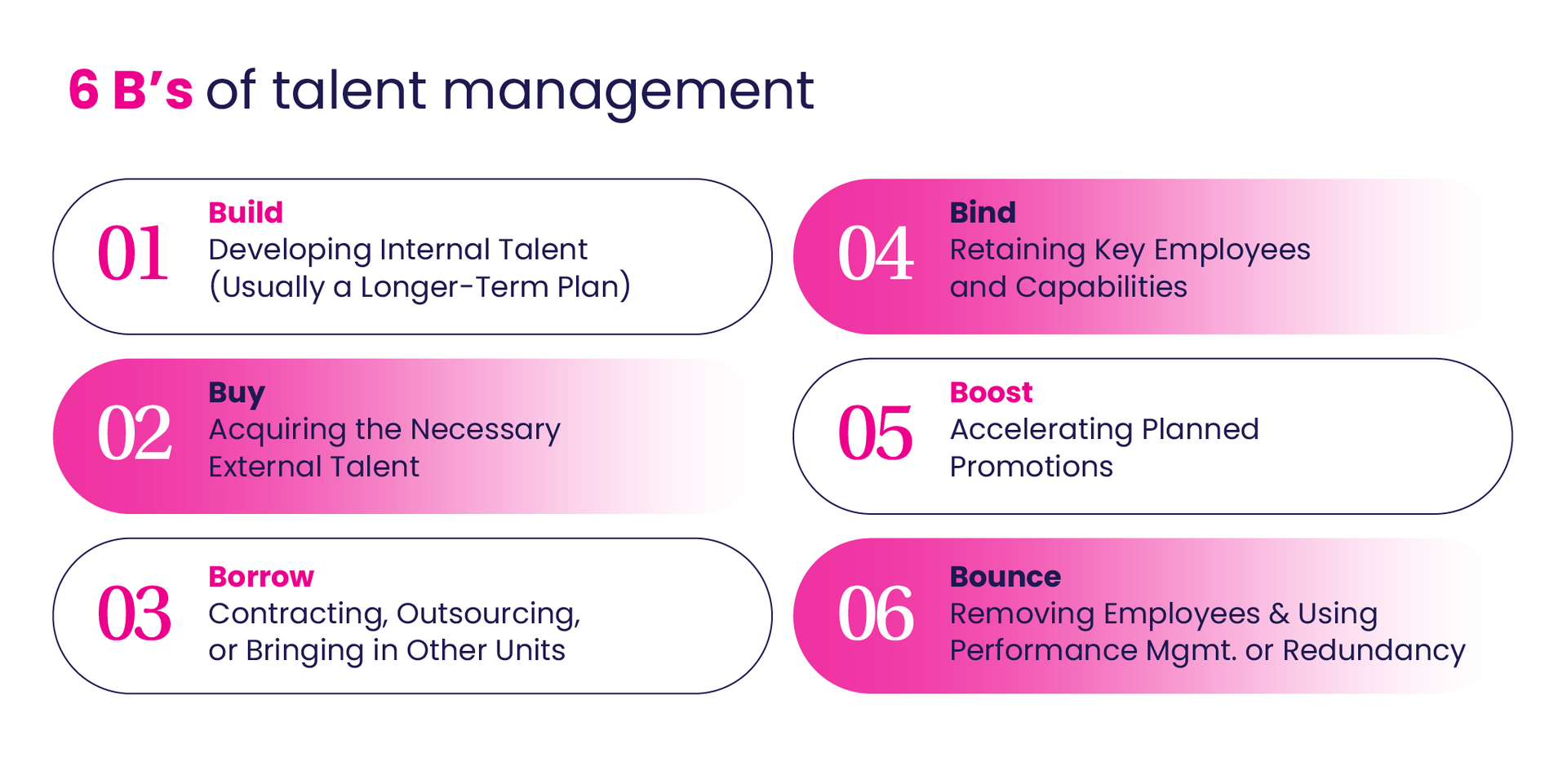
Every business goal has a people implication. Whether you're expanding, innovating or restructuring, ask: What roles are essential? What leadership capabilities are required? Frameworks like the 6Bs of Talent Management: Build, Buy, Borrow, Bind, Boost, Bounce; offer a practical way to think about your workforce composition.
4. Embed DEI with Intention


Make inclusion part of the design not just the messaging. Use equitable evaluation tools, diverse sourcing channels and embed DEI metrics into leadership KPIs.

5. Create Clear Pathways for Growth


Growth isn’t just about promotions, it’s about purpose, stretch and recognition. Build internal mobility programs, offer upskilling aligned to future needs and ensure strengths are being leveraged, not just managed.

6. Measure What Matters


Track engagement, retention, time-to-fill, internal mobility and DEI representation. Use these metrics to refine your strategy and demonstrate ROI.

The Employer Brand Advantage


One of the most underrated benefits of a talent strategy is its impact on employer brand. Organisations known for developing and valuing their people attract top talent.


In a market where candidates research companies before applying, your reputation is built in the little moments – how you onboard, how you promote, how you listen. The companies that become destination employers are the ones that treat their talent strategy with care and consistency.

Final Thoughts


At WOW Recruitment, we believe that people are your greatest asset and your greatest opportunity. A talent strategy isn’t just about filling roles. It’s about building a workforce that’s aligned, engaged and ready for the future.


If you’re re-evaluating how your business attracts, develops, and retains talent, let’s start with a conversation.


Book a complimentary Consultation and discover how WOW can help your organisation lead in the changing world of work.

Book a Meeting with Emily

Because in a world of algorithms and automation, people still hire people. And that’s where WOW shines.


References


ADP Research: People at Work 2025 – Only 16% of Australian employees report being fully engaged.
ADP Australia Report
[au.adp.com]


Bersin by Deloitte: Organisations with a clear talent strategy are 4x more likely to be in the top quartile of business outcomes.
Inside HR Australia
[insidehr.com.au]


Future Skills Organisation: Australia will need 3.5 million skilled finance, tech, and business professionals by 2030, with a projected shortfall of 250,000.
FSO Workforce Plan 2025
[futureskil...ion.com.au]


Australian HR Institute: Only 50% of HR professionals say their organisation prioritises DEI.
AHRI DEI Report
[ahri.com.au]


Adecco Australia: Employer branding is a strategic imperative in attracting and retaining talent.
Adecco Employer Branding


Inside HR: Only 30% of Australian organisations believe their current talent identification approach will meet future needs.
Inside HR Strategy Guide
[insidehr.com.au]


AustCorp Executive: Talent mapping aligns workforce capabilities with long-term business goals.
Talent Mapping Guide


BDO Australia: Build, Buy, Borrow, Bind, Boost, Bounce – a practical framework for workforce planning.
BDO Talent Management


 

By Eydie McLeod December 22, 2025
The Great Resignation put tremendous pressure on companies to attract and retain talent. And while that’s reduced to a great extent now, 55% of employers hired solely to replace departing employees in 2025. Moreover, 38% of employers still report difficulty in recruitment. Both these facts point to one thing: you need a robust recruitment strategy. It’s the key to ensuring business stability as it enables you to get the right talent when you need it. A common dilemma organisations face when building a recruitment strategy is that of choosing between in-house recruitment vs. outsourcing to an agency. Depending on your hiring volume, role complexity, and internal resources, either approach could work. But let’s take a look at them in detail to understand which one is right for you. Cost-Effectiveness Which method works out better for your finances? Lower recruitment costs can help you free up funds for growth and increase profitability. Let’s see how each method stacks up in this regard. In-house Recruitment The costs associated with in-house recruitment majorly comprise of: Staff salaries and benefits Recruitment tools and job board subscriptions Advertising and marketing expenses Onboarding and training costs These are the more “visible” costs, but there are some hidden ones that can increase the impact on your bottom line, such as: Time investment by hiring managers and interviewers Opportunity cost of a vacancy Cost of a bad hire Overworked existing employees until a vacancy is filled That said, in-house recruitment costs don’t come upfront, but add up over time. Also, certain costs like salaries are fixed annual expenses. They could quickly turn into financial drains during periods of low growth. So, it makes sense to opt for this approach only if you have high-volume hiring needs. Recruitment Agency When you opt for a recruitment agency, the upfront costs could be slightly higher as an agency would typically charge a percentage fee of the candidate’s first-year annual salary. Some agencies work on a fixed-fee model as well, where you pay the pre-decided amount on a successful hire. Unlike an in-house setup, you don’t have any recurring costs here. You pay only for a successful outcome, effectively outsourcing the financial risk of the search. Furthermore, recruitment specialists operate as well-oiled machines. Because they focus exclusively on talent acquisition, these firms often possess a deeper understanding of executive requirements and niche markets than a generalist HR team could maintain. Verdict The per-hire costs of in-house recruitment can be lower if you’ve got higher volumes. However, for specialised and one-off hires, agencies provide superior value. The premium demanded by agencies often reflects their market expertise and faster placement outcomes, which result in invisible cost savings. By opting for a fixed-fee or percentage model, you hand over the administrative burden to the agency, freeing you up to focus on other, more pressing matters. Access to Talent - Active vs. Passive Candidate Pools Talent that’s the right fit for your role is out there. But what’s the best way of reaching it? Which method does a better job? In-house Recruitment In-house recruitment teams heavily rely on job boards, ads, and inbound applications for finding the right candidates. These are active candidate pools that include individuals who are actively looking for jobs by searching and applying for them. While effective for junior roles, this approach misses the passive market: high-performing professionals who aren't looking but are willing to move for the right opportunity. That said, in-house teams do get the opportunity to form their own talent pools by connecting with candidates and building relationships with them even before they have new job openings. Recruitment Agency Here at WOW Recruitment, you gain access to both active and passive talent pools. Since they’re solely focused on recruitment, agencies are able to tap into passive candidates through the strong networks they’ve built over the years. This proactive approach comes in handy, especially when you’re looking for niche and senior hires. You gain access to pools that are otherwise out of your in-house team’s reach. For mission-critical or confidential roles where public advertising is a risk, an agency provides the necessary layer of anonymity while still ensuring a robust shortlist. Verdict Recruitment agencies give you access to a much larger candidate pool. You can rely on their existing network to even hire for confidential roles. In-house teams don’t have that edge, but can build it over time. Time-to-Hire and Business Continuity Leaving a position vacant for too long is a risk. Case in point – delayed hiring cycles negatively impact 92% of businesses , often stalling projects and damaging team morale. Here’s how each method fares in this regard: In-house Recruitment In-house teams juggle a broad spectrum of responsibilities, from payroll and compensation to employee training. Recruitment is just one of the competing priorities here, inevitably leading to a longer time-to-hire. Additionally, the in-house team needs to build talent pools from scratch and also has to spend a lot more time on internal alignment. They may sometimes lack the right set of tools to execute their hiring tasks efficiently too. Learn More: 3 Ways to Speed Up Your Hiring Process | WOW Recruitment Recruitment Agency Unlike in-house teams, recruitment agencies are solely focused on finding the right candidate for your business. By using tried-and-tested processes, they can easily discover candidates, tapping into their existing talent pools. They also possess the right tech stack for a smooth end-to-end management of the recruitment campaign. Finally, agencies are motivated by speed as they are only paid for each successful hire. It naturally accelerates the hiring timeline. Verdict A shorter hiring time means your vacancies can be filled quickly with minimal disruption to your business, ensuring continuity. Recruitment agencies can help you fill the vacancies faster than in-house teams, making them a better option. That said, if you have a dedicated team for hiring and need to hire continuously, an in-house team should be your go-to strategy. Improve Your Hiring Outcomes Both in-house teams and recruitment agencies can help you power up your hiring campaigns. However, the right choice depends on your business context. It’s best to assess your hiring urgency, complexity, and internal capability before making a decision. If you’re looking for a shorter time-to-hire, want to keep things confidential, or need to fill executive positions, agencies are the better option. If you’re evaluating which method works better for your business, let’s talk. At WOW Recruitment, we make hiring talent (both permanent and temporary) seamless. Want to experience WOW? Contact us today.
Defining ROI on Creativity
By Eydie McLeod, WOW Recruitment October 10, 2025
Discover how creativity drives ROI - from emotional impact to business value. Insights from top marketers on turning ideas into measurable success.
By Emily Angeloni (McLeod) October 1, 2025
PRESS RELEASE WOW Recruitment expands into Brisbane  1 October 2025
More Posts