Leading Young, Leading Strong: WOW’s Co-founder Emily McLeod
Leading a team of 25 at age 19? Co-founding a company by 22?
It’s certainly an impressive feat – and one WOW’s co-founder and director, Emily McLeod, achieved right at the beginning of her career.
Here, Emily shares her leadership journey, one that took her from engineering to sales and finally recruitment. She provides key insights into the challenges she’s faced, the lessons she’s learned, as well as some great leadership advice for current and emerging leaders in Australia.
Emily’s Leadership Journey
Straight out of high school, Emily began studying for an engineering degree, as according to her career advisor, that’s where her strengths lay.
“But I absolutely hated it. It was so dry, and I just didn’t enjoy the process. I was also the only girl in my class,” she explains.
Knowing she couldn’t face becoming an engineer, Emily scouted around for something totally different. She landed a sales job under the leadership of Daniel Tonkin, who went on to become a colleague, a friend but most importantly, her eventual co-founder of WOW.
“When I started in the sales job, I was 18. Within six months, I was promoted to a leadership role. Within 12 months, I was managing a team of 25 sales reps. It was my first taste of leadership and leading a performance- and results-driven organisation,” she says.
“As it was an entry-level sales organisation, we had a lot of young travellers and students who didn’t know what they wanted from their career yet. My one-on-one sessions focused on coaching them through what they actually wanted to do with their career, and I really enjoyed that aspect,” she says.
After spending a few years at the company, Emily began looking for another sales role, hoping for something with a corporate focus. But as she interviewed with a recruiter, they asked her a question she wasn’t expecting.
“They said ‘Have you thought about going into recruitment?’ And I replied, ‘I have no idea what recruiters even do!’. In the meantime, the CEO came into the meeting room to join the conversation and gave me more food for thought. I went home, mulled it over and ended up accepting the role as I felt like it would really suit my skillset. And I was right!” she laughs.
After spending a few years at the recruitment agency and getting a further taste of coaching others, she and Daniel decided to make a go of it themselves. They founded WOW when Emily was just 22.
“And I guess the rest is history,” she says.
Overcoming Challenges and Embracing Authenticity
In just eight years of working professionally, Emily has managed to achieve what others have worked at for decades. But that doesn’t mean it was easy. During this time, she’s faced many challenges and learned a number of valuable lessons that have continued to empower her throughout her career.
Misalignment when internal recruiting
As any leader will tell you, finding the right people for your team is one of the most crucial (and often most difficult) parts of establishing and growing your business, and Emily is no stranger to this struggle.
“When we first founded WOW, the biggest challenge we faced was hiring the right people. I found that so frustrating because I’m a recruiter – I’m supposed to be able to hire good people!” she laughs.
“In those early days, we hired people who didn’t have a lot of experience so I had to spend chunks of my time training them. It was difficult to balance because I was also the only one generating the business revenue.”
“After making the mistake of recruiting rookies with our first three or four hires, we realised we didn’t have the systems and processes in place to train them. We rejigged our budget and put more money into salaries to bring on experienced professionals. It’s only now we’re in a position where we can train rookies because we have the right framework in place.”
Emily explains that a big part of establishing a successful hiring framework is understanding the ‘why’ behind your business, and the driving forces behind it.
“Another mistake we made was not adequately defining our vision, mission and values before interviewing. We just hired based on our gut instincts. After getting it wrong those first few times, we sat down and nutted out our values and our vision of what we were trying to create with WOW. We then focused our interviews on ensuring our candidates aligned with these. Once we did that, we made some awesome hiring decisions and started to build a very powerful team .”
Leading came naturally but explaining it didn’t
Despite being so young when she took on her first leadership role, Emily never allowed her position to intimidate her or distract her from what she did best.
“I never looked for a leadership role – it kind of found me,” Emily explains. “Daniel used to say that I made it look so easy but all I was doing was leading by example, and people seem to find that inspiring. Because it happened so organically, I never found leading intimidating.”
“What I did find intimidating – and one of my biggest challenges – was trying to explain my process for success. I knew I was a great recruiter, but I couldn’t figure out how to make others great recruiters too. But I had to learn how to do that pretty quickly because as we started to grow, clients wanted to work directly with me at WOW, but I didn’t have the capacity to service everybody.”
“The way we solved that problem and kicked into growth mode was by ‘bottling the magic’ of systems and structures, moving it from being the ‘Emily way’ to it being the ‘WOW way’”
It was from this experience of distilling Emily’s approach that WOW’s five steps to recruitment happiness were born.
“It enables our clients to trust our process as a team versus my process as an individual,” she says.
“Now, everything that gets done more than once here at WOW needs to have a system behind it. We’ve got a training library which has videos, templates and checklists. We even have a system for creating a system!”
Like many other sectors, the recruitment industry faces major challenges in attracting and retaining talent. Emily explains that having systems and training in place is the best way to encourage and foster people’s growth, and create an environment where people stay long term.
“It really shows that recruitment can be a career, not just a ‘two-year gap filler’ industry.”
Dealing with imposter syndrome
For women in leadership, imposter syndrome is statistically more common than it is in men. Emily is no stranger to this feeling and has realised that isolation is often a trigger.
“It’s certainly been a big challenge for me. Sometimes you feel like you don’t deserve the accolades, or that you’re a fraud. I really struggled with that during COVID because I was at home and isolated. I couldn’t connect in person with my team and get that reality check first-hand in seeing what we’ve all created,” she explains.
Over the years, Emily has developed a number of strategies for dealing with imposter syndrome when it strikes.
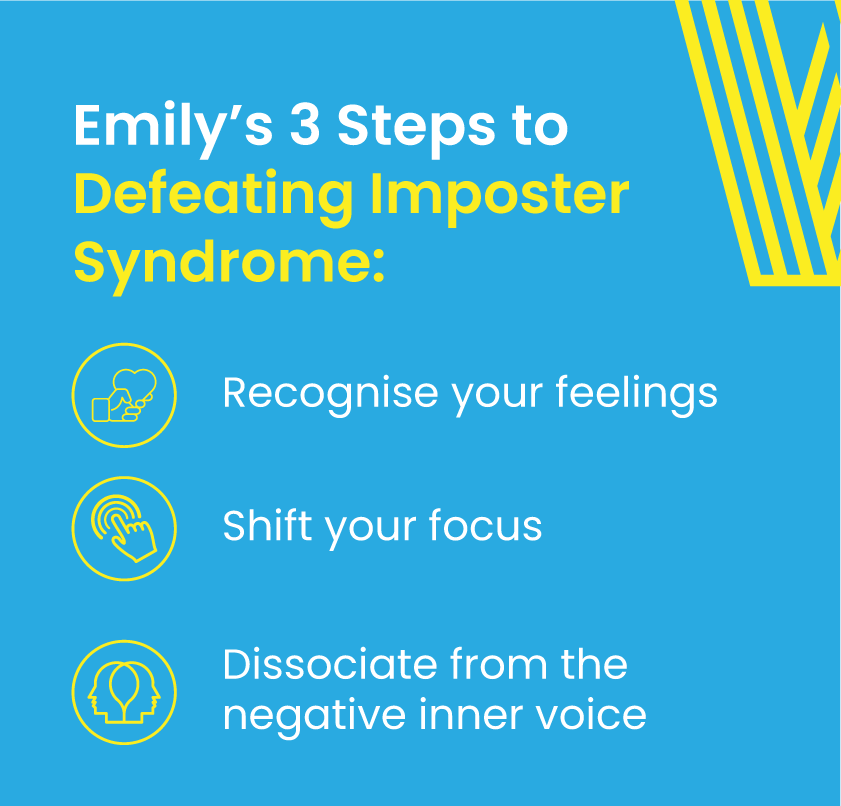
“I can’t say I’ve nailed the solution yet, but I’ve built a framework to manage it, drawing from advice from other female leaders I’ve talked to. The first step is to be aware of it and I do this through stillness practices like meditation or yoga. The second thing is remembering I have a choice of where to put my focus. The last part is consciously disassociating when that impostor syndrome voice starts to creep in. It’s obviously quite uncomfortable to do, requires a lot of self-awareness, and it’s a work in progress.”
Embracing vulnerability
It’s natural for people in leadership to feel they have to hide vulnerability and put on a ‘brave face’, but Emily is a firm believer that an unwillingness or inability to be vulnerable prevents many leaders from being as effective as they could be. Afterall, it’s the people who have overcome challenges or adversity who we often find most inspiring.
“During the pandemic, there was a lot of conversation within leadership networks about the power of embracing vulnerability during times of change. And I felt like I needed to step outside my comfort zone during that time and embrace it as well,” she says.
“I forced myself to learn to be okay with sharing my weaknesses and struggles. And in doing so, I started to enjoy my role even more as I was being me. Being open to being vulnerable also helped me to connect with our staff on a level I’ve never been able to do before. It was a powerful tool that empowered the rest of the team as well. I thought it would do the opposite, but it actually gave me a bit more influence within the team. That was a huge learning curve, even though it wasn’t very comfortable to do!”
This commitment to personal growth and genuine connection with others has guided Emily throughout her career, and is the driving force behind the way she interacts with her team, clients and candidates. She believes in understanding what matters to each individual, and actively prioritising both physical and mental wellbeing. Ultimately, this is her advice for emerging leaders: to look after the whole person.
Looking for more leadership advice or want to know more about how we nurture careers? Please get in touch with us to find out more about the WOW way.